
Firm, clean compute. Off grid, off land.
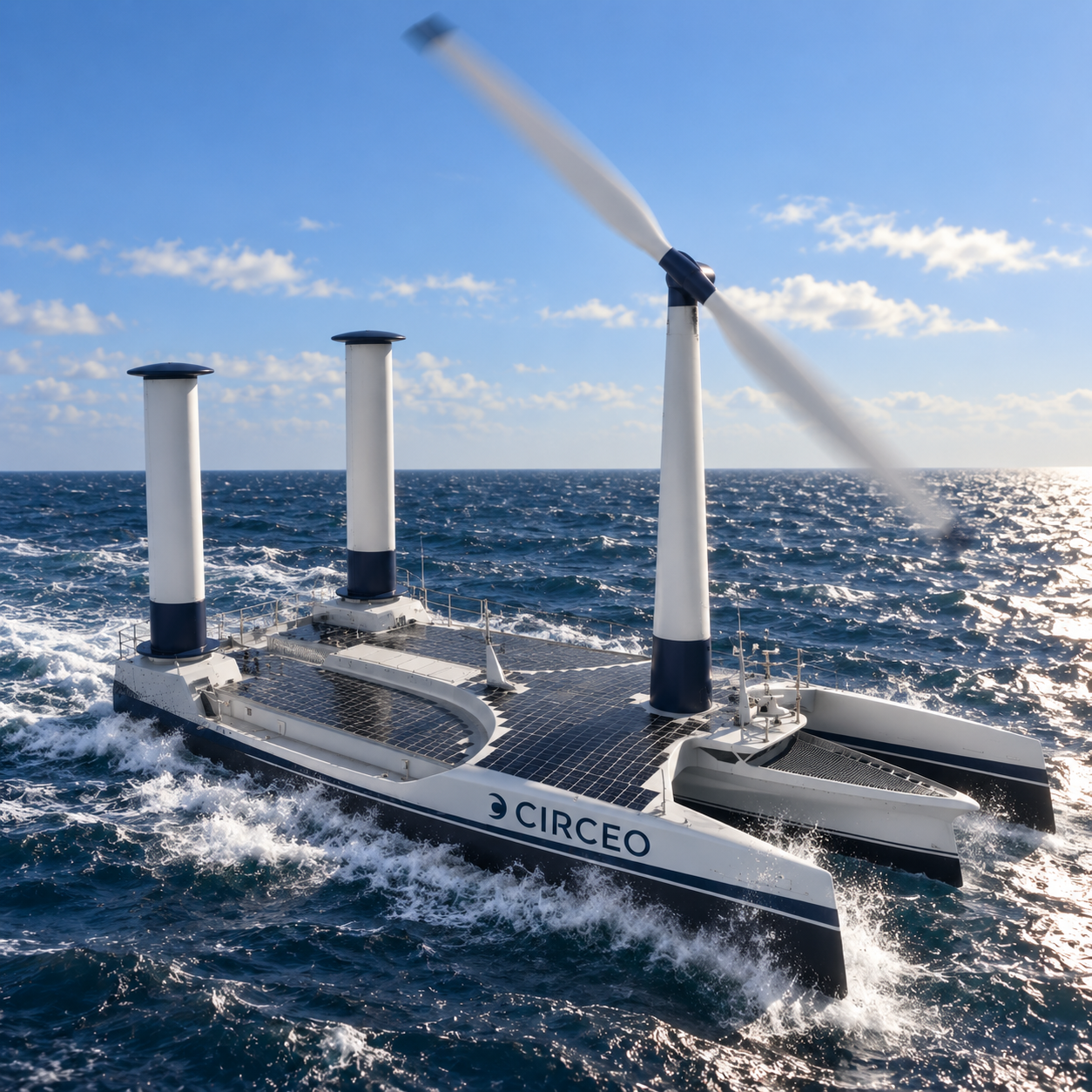
A floating data center that generates its own power. High-density racks, ocean-cooled, running on megawatts nobody else is harvesting.
The solution
A data centre that goes to the energy.
AI compute is no longer constrained by chips. It is constrained by power.
Grid connection queues for data centres take 5–10 years, freshwater is contested, and land is scarce. Meanwhile, the planet’s densest energy resource blows over open ocean, completely unused.
CIRCEO couples that wind directly to seawater-cooled IT inside autonomous hulls. Megawatts are consumed metres from generation : no transmission, no permits. Fleets scale by hull rather than substation, deploying compute wherever customers require it.
- Queue elimination
Zerogrid connection queues
- Resource preservation
Zerofreshwater draw
- Terrestrial impact
Zeroland take
- Emissions baseline
Ultra Lowcarbon intensity
Just firm, clean, unlimited power for the next era of intelligence.
The constraint is megawatts, not chips.
Data-centre demand is exploding. Chips and capital are available; power, cooling and sites are not. On land a new site waits years for a grid connection, competes with homes and industry for the same electrons, and negotiates for water and acceptance. At sea, none of those queues exist.
Additional power, not diverted power
Every megawatt we make is produced where nobody else can produce: far offshore. It is not taken from homes, industry or the local grid, and it does not need a connection agreement.
Siting freedom
A vessel can operate where it makes sense for you, including in your own waters and under your own flag. No land to buy, no permit cycle, no moratorium risk.
Cooling without compromise
The ocean is an unlimited heat sink. Seawater cooling means no chillers, no freshwater draw and no water permit. It makes the densest liquid-cooled racks easy to run.
An industrial clock, not a permitting clock
Fabrication is the only critical path: under eighteen months from order to sailing, and capacity grows one vessel at a time instead of one grid upgrade at a time.
The floating data centre
A marinised high-density compute module sits inside the hull of the ship, next to the power it consumes. Nothing travels through a grid: the electron is produced, consumed and sold as compute on board.
- 01
Firm power on board
A hybrid mix of wind, solar, a 2 MWh battery, and a generator delivers over 99% power availability for 2.4 MW of onboard IT. Weather routing keeps the vessel in steady winds, limiting generator output to under 10% of total energy while providing full redundancy.
- 02
Infinite cooling
A dual loop: internal glycol cools the chips, an external seawater loop extracts the heat through titanium exchangers. PUE < 1.10. No chiller, no freshwater, no water permit.
- 03
Built for the sea
Inerted containers protect the hardware from salt; double mechanical decoupling filters the motion of the platform so the racks never feel the swell.
- 04
Connectivity
Multi-Gbps constellation satellite links paired with a high-bandwidth mesh network across the fleet for distributed training. Massive datasets travel physically with each routine port call
- 05
Serviceable and upgradeable
A vessel is boardable in under an hour, stops in harbour regularly and is re-racked at each two-year dry dock. The power and cooling backbone stays in place; only the compute hardware changes generation.
What a flotilla delivers
How we can work together
We are not selling a catalogue yet. These are the directions we are shaping with the first teams who talk to us. The common thread is simple: workloads that need megawatts more than milliseconds.
Scheduled, renewable-only compute
Wind, solar and battery only, checkpoint-scheduled around the weather. Very low carbon intensity and fully additional power, for teams that can place their batches in time.
Firm capacity
The same racks with generator firming and shore power at pit stops, for workloads that need a guaranteed slot with a contractual availability commitment.
Sovereign data vault
An autonomous, air-gapped cold data facility at sea, with data spread across the fleet so no single vessel holds the risk.
Where it fits today
- Reinforcement learning and post-training
- Batch and queued inference
- Fine-tuning of mid-range models
- Synthetic data generation and evaluations
- Long-term sovereign data storage
- Interactive, millisecond-latency inference
- Frontier pretraining on a single giant cluster
Your workload is not on the list? Tell us what it needs. We are designing the first vessels now, and the first conversations shape what we build.
Megawatts nobody queued for, delivered as compute.